
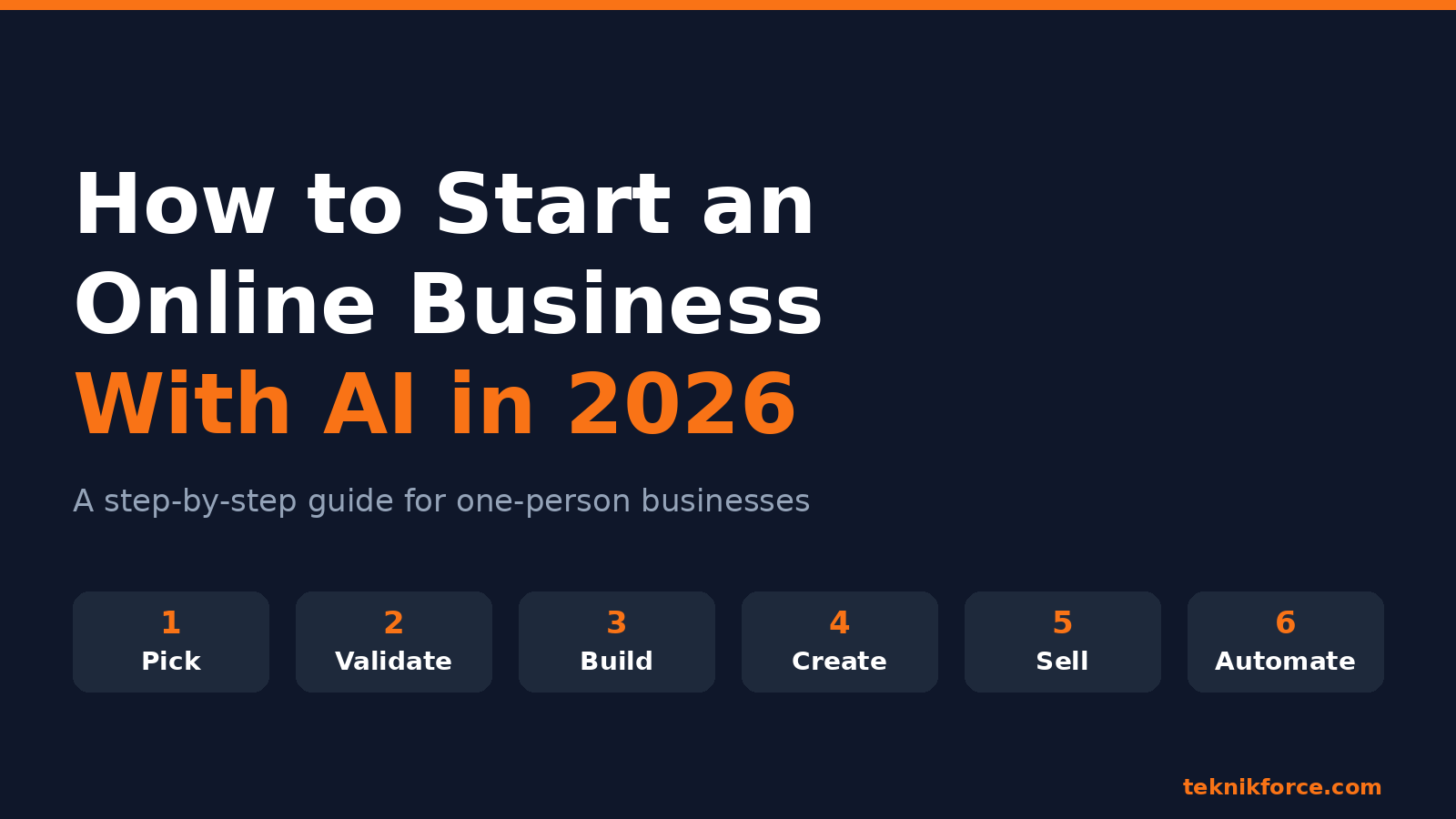
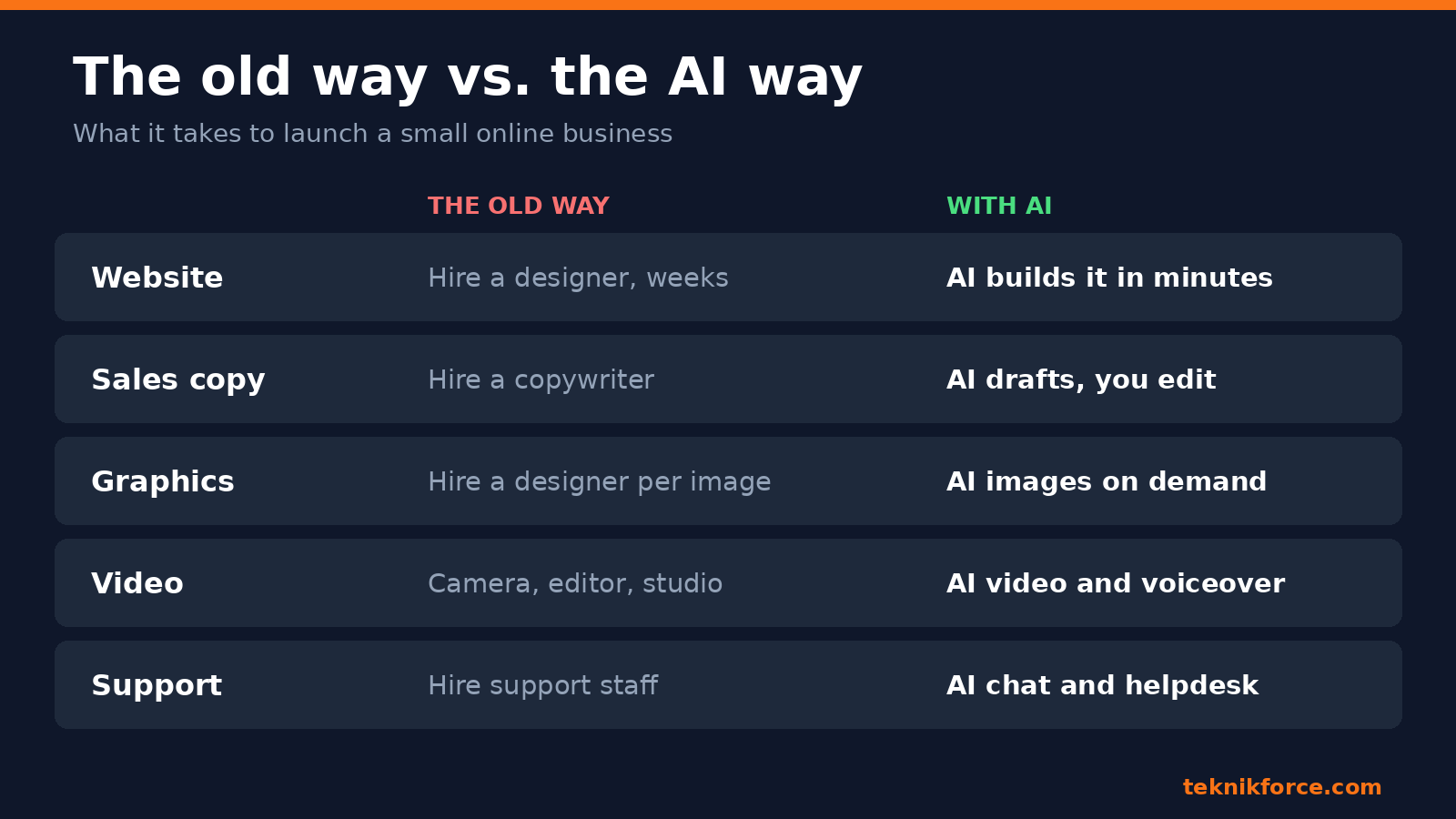
Five years ago, starting an online business meant hiring a designer, a copywriter, a video editor and maybe a developer.
Today you need a laptop, an idea and a few AI tools.
I've been building software for online businesses at Teknikforce for well over a decade, and I've never seen the barrier to entry this low. One person can now do what used to take a small team.
This guide walks you through the whole thing, step by step. No fluff, no get-rich-quick promises. Just the steps that actually work in 2026.
Why 2026 Is the Best Time to Start
People are starting businesses at a record pace.
Americans have filed more than 5 million new business applications every single year since 2021, according to the US Census Bureau. That never happened once in the decade before.
And small businesses have gone all in on AI. The US Chamber of Commerce found that 58% of small businesses used generative AI in 2025, up from just 23% in 2023.
Why does that matter to you?
Because the work that used to eat your budget, writing, design, video, customer support, is now cheap and fast. The thing that's still scarce is someone willing to start.
What You Actually Need
Less than you think.
- A problem you can solve for a specific group of people.
- A way to deliver it online, like a course, a product, a service or content.
- A website and a way to take payments.
- A way to reach people, through search, social, email or ads.
- A few hours a day and a little patience.
That's it. Notice what's not on the list. No office, no inventory you can't afford, no team.
Step 1. Pick a Business Model You Can Run Alone
This is the most important decision you'll make, so don't rush it.
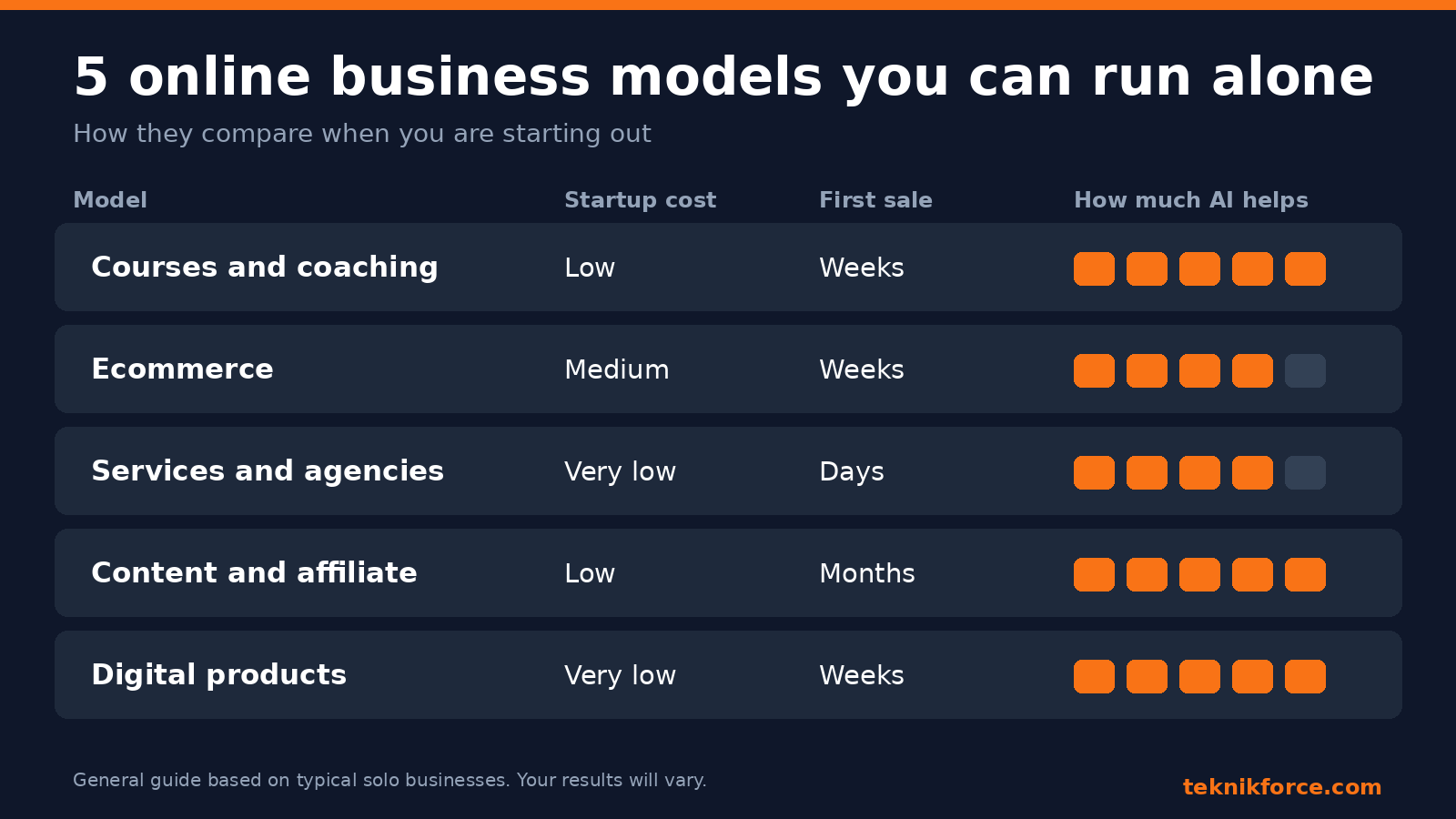
Here are the five models I see working best for one-person businesses right now.
- Online courses and coaching. You sell what you know. Low cost, high margins, and AI helps you build the content fast.
- Ecommerce. You sell physical or digital products. Print-on-demand and dropshipping mean you don't need a warehouse.
- Services and agencies. You sell done-for-you work, like websites, social media or ads. AI lets one person serve many clients.
- Content and affiliate sites. You build an audience with blogs or videos, then earn from ads and commissions.
- Digital products. Templates, ebooks, prompt packs, printables. Make it once, sell it forever.
My advice?
Start with what you already know. A nurse who sells a course on passing nursing exams will beat a stranger selling generic productivity tips every time.
Step 2. Validate Your Idea Before You Build Anything
Most new businesses fail for one simple reason. Nobody wanted what they built.
So test demand first. It takes a weekend.
- Ask AI to play your customer. Describe your audience and ask ChatGPT or Claude what they struggle with, what they've tried and what they'd pay for.
- Check real conversations. Search Reddit, Facebook groups and YouTube comments for people asking about your topic.
- Look at search demand. Free tools like Google Trends show whether interest is growing or fading.
- Find competitors. Competition is good news. It means people are already paying.
- Pre-sell it. Put up a simple page and see if anyone signs up or pays before you build the full thing.
If you're thinking about a course, we wrote a full guide on how to validate an online course idea before you build it.
Step 3. Set Up the Boring Basics
Nobody gets excited about this part, but it saves you headaches later.
- Pick a name that's short, easy to spell and has a domain available. AI is great at brainstorming 50 options in seconds.
- Buy your domain from any registrar. A .com is still best if you can get it.
- Register your business the way your country requires. In the US, many solo founders start as an LLC.
- Open a separate bank account so business money never mixes with personal money.
- Set up payments with Stripe or PayPal.
Don't spend more than a few days here. It's easy to hide in setup tasks because they feel productive.
Step 4. Build Your Website With AI
You don't need to hire a designer anymore.
With Webira, you type in a few details about your business and AI builds the whole website for you, including pages, copy and images. You can tweak anything afterwards.
Keep the first version simple. A home page, an about page, your offer and a way to contact you. You can always add more later.
One tip. Write your own about page, or at least edit what AI gives you. People buy from people, and that page is where they decide if they trust you.
Step 5. Build the Thing You Sell
This step depends on the model you picked in Step 1.
If you're selling a course
CourseFunnels gives you the course platform, landing pages and email marketing in one place, so you don't have to glue three tools together. Use AI to outline your modules, draft your lessons and write your quizzes, then record in your own voice.
If you're selling products
ShopFunnels sets up an online store on your own site in about ten minutes, with payment gateways, memberships and email built in. AI can write all your product descriptions in an afternoon.
If you're selling services or digital products
A simple sales funnel works best. CloudFunnels lets you build landing pages, order forms and upsells from ready-made templates, without paying monthly fees that grow as you grow.
Whatever you sell, launch a smaller version first. One course module. Five products. One service package. Then grow it based on what people actually buy.
Step 6. Create Content With AI, Without Sounding Like a Robot
Content is how people find you. And AI has made it ridiculously fast to produce.
Here's the stack I'd use.
- Writing. Writix gives you ready-made AI workflows for blog posts, emails and social posts, so you don't have to fight with prompts. Blogi can write and publish long-tail SEO articles to your blog on autopilot.
- Images. Pixci puts 25+ image AIs in one place for thumbnails, ads, logos and product photos.
- Video. Vidko gives you many of the top video AIs in one dashboard for shorts, B-roll and explainers.
- Voice. Voisi has 450+ lifelike voices for voiceovers, podcasts and translations.
Now the important part.
Don't just publish what AI spits out. Add your own stories, opinions and examples. AI can write a decent article about starting a bakery, but only you can tell readers about the morning your oven died before a big order.
That's what makes people remember you.
Step 7. Get Your First Customers
This is where most people stall. Building is comfortable. Selling feels scary.
Push through it. Your first ten customers will teach you more than any course.
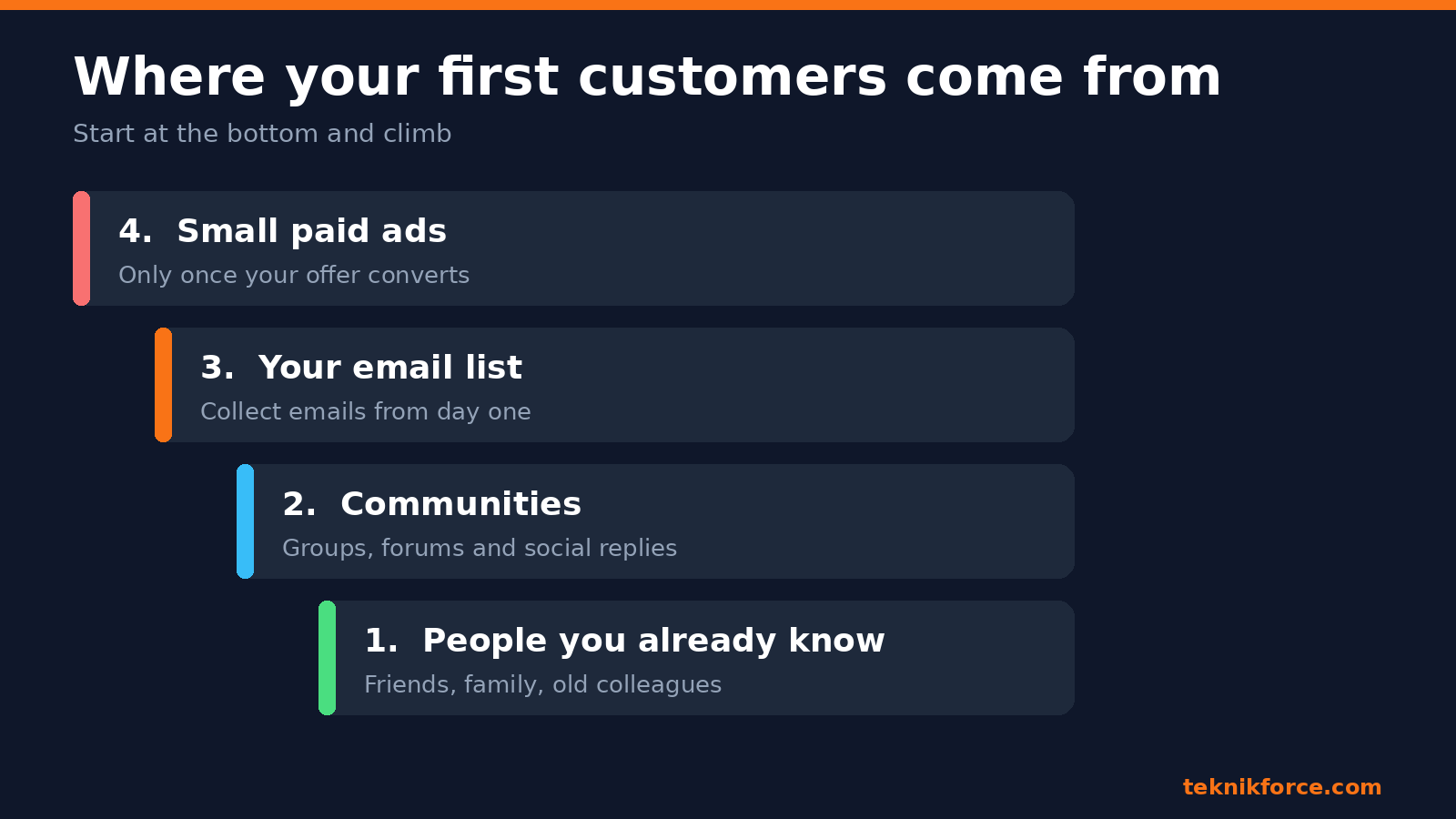
- Tell everyone you know. Seriously. Friends, family, old colleagues. Your first sale often comes from someone who already trusts you.
- Show up where your customers hang out. Join groups and communities, answer questions and be genuinely helpful. Engagi helps you write thoughtful comments and replies on Facebook, X and LinkedIn, and Grupster lets you share your posts across your Facebook groups in one click.
- Start an email list from day one. Social media can disappear overnight. Your list can't. Sendster is a self-hosted newsletter platform that sends around 10,000 emails for about a dollar through Amazon SES.
- Try small ad tests. Once you know your offer converts, a small Facebook ad budget can speed things up. Adplify helps you find hidden audiences and watch what your competitors are running.
Step 8. Turn Visitors Into Buyers
Getting traffic is only half the job. Most visitors leave without buying.
A few things help a lot.
- Social proof. Converti adds sales notifications, reviews and other trust widgets to your pages.
- Instant answers. PeopleBots puts an AI chat on your website that learns your business and answers questions while you sleep.
- Webinars. For higher-priced offers, an automated webinar with Webinarloop can sell for you around the clock.
And keep your offer simple. One clear product, one clear price, one clear button.
Step 9. Automate the Busywork
As you grow, support emails and admin start piling up.
This is where AI really pays for itself.
- Support. Helpira drafts answers to customer questions so you only have to review and send.
- Phone calls. Callsi gives you a human-sounding AI phone agent for appointments, follow-ups and reminders.
- Repetitive writing. Save your best prompts and workflows so you never write the same thing twice.
A good rule. If you do something more than three times a week, find a way to automate it.
Step 10. Measure, Learn and Keep Going
Check a few numbers every week.
- Visitors. How many people found you?
- Leads. How many joined your email list?
- Sales. How many bought, and what was your average order?
- Where they came from. Double down on what works and drop what doesn't.
Then improve one thing at a time. A better headline. A new lead magnet. One more traffic channel.
Small improvements stack up faster than you'd expect.
A Quick Example, From Idea to First Sale
Let's make this real.
Meet Priya. She's a yoga teacher who's been teaching in-person classes for eight years. She wants to earn online, but she's not technical and she doesn't have a big budget.
Here's how she could do it in about a month.
- Week one. She picks a model, an online course on yoga for back pain, because her students ask about it constantly. She asks AI to list the biggest worries of people with back pain, then checks Reddit and Facebook groups to confirm them.
- Week two. She sets up a simple page offering the course at an early-bird price, and shares it with her current students and two Facebook groups. Eleven people pre-order. The idea is validated.
- Week three. She builds the website with Webira and the course with CourseFunnels. AI outlines her six modules and drafts her lesson scripts, which she rewrites in her own words before recording on her phone.
- Week four. She launches to her pre-order list, starts a weekly email with Sendster and posts short clips made with Vidko. She makes her first sales from people who've never taken her classes.
Nothing fancy. No team. No big investment.
Just one clear problem, one clear offer and AI doing the heavy lifting in the background.
Your 30-Day Launch Plan
If you like checklists, here's the whole guide boiled down.
- Days 1 to 3. Choose your model and your audience.
- Days 4 to 7. Validate the idea and try to pre-sell it.
- Days 8 to 10. Name it, buy the domain and set up payments.
- Days 11 to 17. Build your website and the first version of your product.
- Days 18 to 24. Create your first batch of content and start your email list.
- Days 25 to 30. Launch, reach out to your first customers and track your numbers.
Thirty days won't make you rich. But it will take you from idea to a real business that people can buy from, and that's further than most people ever get.
What It Costs to Start
This is the part that surprises people the most.
You can run a real online business for a few hundred dollars a year. Most Teknikforce tools cost $67 a year, and they run on your own site, so your costs don't jump every time you grow.
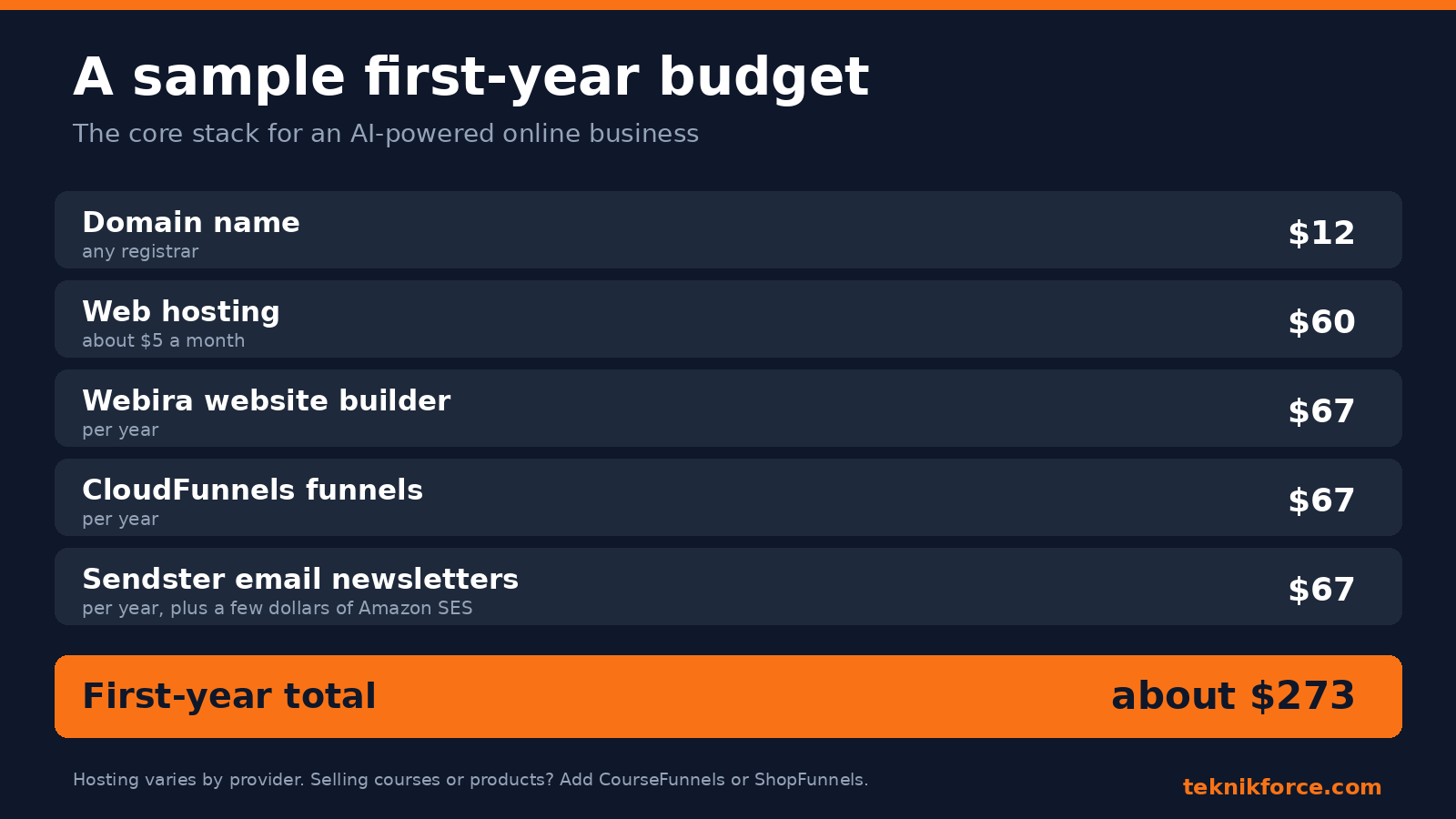
Compare that with the thousands it used to take to hire a designer, a writer and a developer before you'd made a single sale.
Common Mistakes to Avoid
- Building for months before selling. Launch small and fast.
- Chasing every new AI tool. Pick a few and get good at them.
- Publishing raw AI content. Always edit, fact-check and add your own voice.
- Trying to serve everyone. A narrow audience is easier to reach and easier to sell to.
- Quitting too early. Most businesses take six to twelve months to find their feet.
Frequently Asked Questions
Can I really start an online business with no money?
Almost. You'll need a domain and some basic tools, which can cost less than $300 for the whole first year. Many AI tools also have free plans to get you started.
What is the easiest online business to start with AI?
For most people it's selling a course or a service based on something they already know. You don't need inventory, and AI can help you create the content and marketing quickly.
Do I need technical skills?
No. Tools like Webira, CloudFunnels and ShopFunnels are built for people who have never written a line of code.
How long does it take to make the first sale?
It varies a lot. Some people make a sale within a few weeks of launching, others take a few months. Pre-selling during validation is the fastest way to get there.
Will AI replace the need for my own skills?
No. AI handles the heavy lifting, but your knowledge, judgment and personality are what make people buy from you instead of someone else.
Final Thoughts
There's never been a cheaper or faster time to start an online business.
AI won't build the business for you. But it will do the work that used to stop people from starting at all.
Pick a model. Validate it this weekend. Build a small version. Find your first ten customers.
Then keep going.
If you want the tools to do it, explore everything we make at Teknikforce.